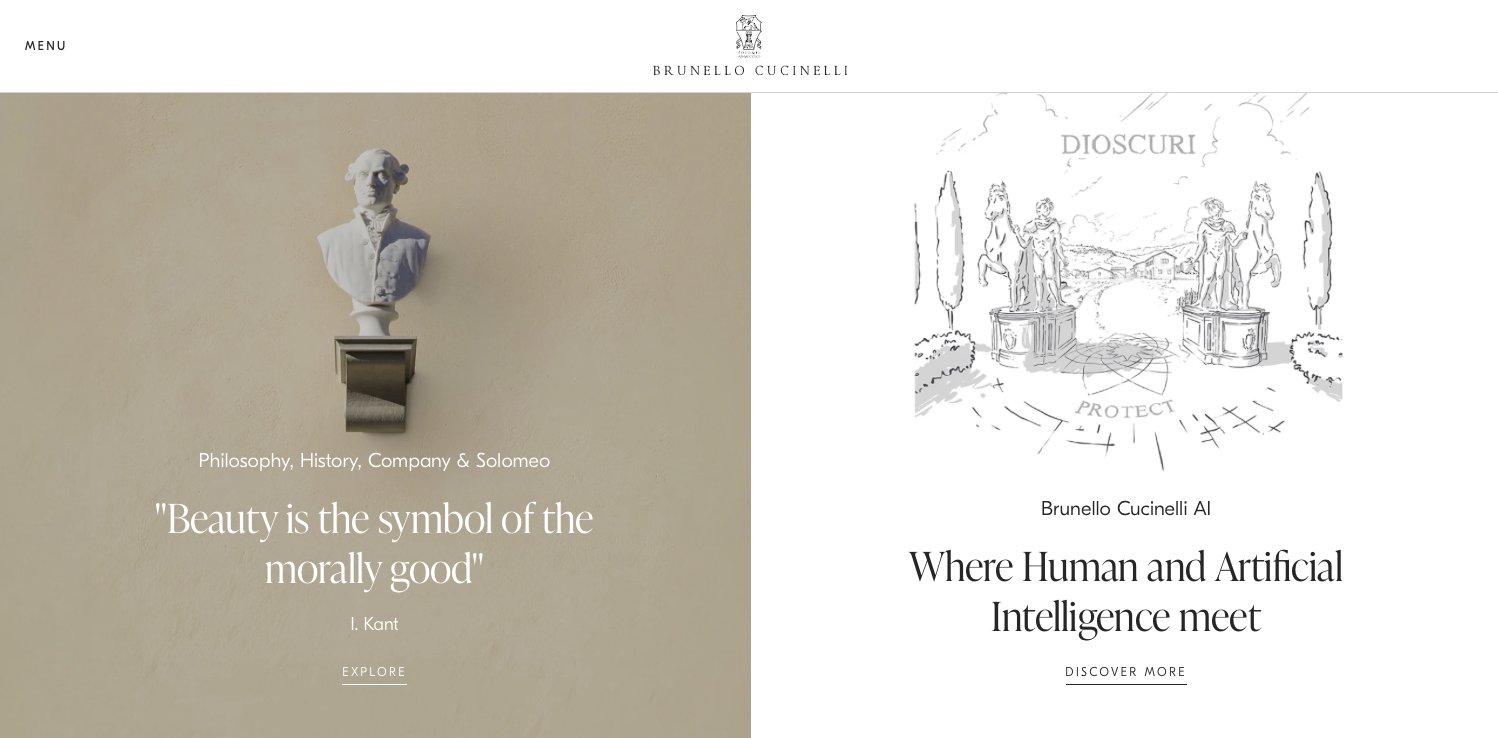
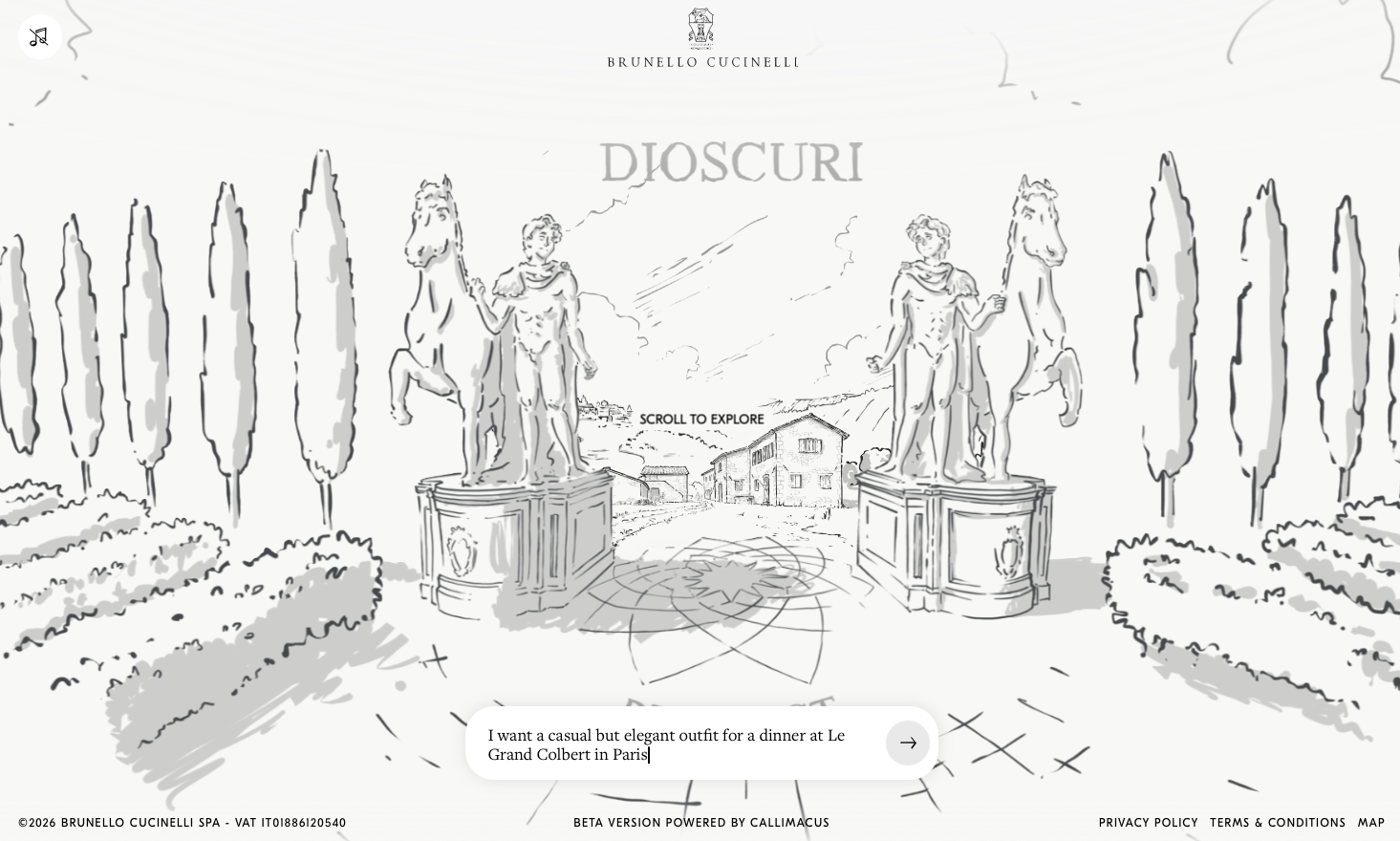
Callimacus as Experience Architecture
Against this background, Callimacus itself can be read differently than many initial reports have suggested. The platform is not conceived as a conventional online shop that refines or replaces familiar navigation patterns. Much rather, there are indications that a conscious break has been made with the assumption that digital experience must be organised along fixed page structures.
Callimacus appears to be designed as a kind of experience layer that draws content together situationally. Rather than guiding users through predefined paths, the system responds to contexts, movements, and inferred intentions. Interaction follows less a linear logic than a narrative one.
What is notable here is not so much the individual technological component, but their composition. Semantic analysis, rule-based control, and adaptive delivery are familiar tools. What is new is the manner of their deployment. Decisions are not taken over, but prepared. People are not removed from the process; they are accompanied.
Callimacus thus does not act as an agent in the classical sense. It does not act on behalf of the user; it moderates. The decision remains visibly with the human. Technology orders, structures, and opens spaces in which perception can occur. The new platform is already available in Italy, the United States, and the United Kingdom, with further markets to follow in the coming months.
⸻
A Space Between Intent and Decision
Digital systems in commerce are frequently built upon the assumption that goals can be clearly articulated and pathways precisely delineated. Users approach the system with a particular expectation, and the system responds by offering orientation and condensing processes. Interaction follows a logic of abbreviation, designed to minimise friction between starting point and outcome.
Callimacus proceeds from a different point. The digital environment opens a space in which attention is permitted to move and impressions may coexist without being immediately converted into a decision. Perception is given time to unfold, and experience develops not along a predetermined path, but from a sequence of individual encounters.
This openness is closely related to the way the brand itself communicates. Materials, provenance, craft processes, and cultural references appear not in isolation, but in a context that reveals itself only through contemplation. The digital experience takes up this structure and translates it into a form that allows movement without prescribing direction.
Decisions do not arise abruptly in this space. They form over time, as impressions enter into relation with one another and meanings gradually take shape. Technology accompanies this process by enabling transitions and keeping connections visible. It remains present without pushing itself to the fore.
⸻
The Role of Technology in the Background
The technical structure of Callimacus does not present itself as a subject in its own right. It remains in the background of the experience and exerts its influence where transitions occur. Content is brought into relation, contexts are interwoven, and movement across the surface is kept fluid.
What stands out is the restraint with which technical means are deployed. The concern is less with the visibility of individual functions than with a form of order that enables orientation without prescribing it. The architecture carries the experience without commenting on or explaining it.
This restraint presupposes trust. Trust that users are willing to engage with an environment that does not impose immediate objectives. Trust that meaning emerges from the interplay of elements, not from their emphasis. Technology assumes here the role of a quiet frame that enables presence whilst maintaining distance.
⸻
A Movement Through the Space
One enters the surface without the impulse to orientate oneself. There is no moment in which one searches for a structure or asks for a destination. The gaze lingers, glides onward, comes to rest again. Between fabrics, colours, and forms, a quiet relationship arises, one that is not directed but settles of its own accord.
The experience resembles a slow traversal more than navigation. Images draw closer, recede, lose their sharpness in favour of other impressions. Texts appear incidentally, almost like marginal notes, and disappear again without making demands. A sense of continuity emerges, constituted less by direction than by rhythm.
Time plays its own role here. It is not measured, not interrupted, not remarked upon. It stretches whilst one lingers and contracts as the gaze wanders onward. Decisions do not hang in the air; they do not press themselves forward. What remains is an impression of coherence that only reveals itself as orientation in hindsight.
⸻
An Afterglow
What remains after the encounter is not a clearly defined thought. Rather, an afterglow that cannot immediately be named. Individual images resurface later, detached from their original context, and merge with other impressions. The experience continues to work, even long after one has left it behind.
This form of effect is difficult to measure. It unfolds not in the moment of use, but in the time that follows. Memory and perception overlap without drawing a clear boundary. Meaning emerges step by step, almost imperceptibly, and gains contour only in retrospect.
In this afterglow, a quality becomes visible that has become rare in the digital realm. The surface demands nothing. It leaves something behind. And therein lies its effect.
⸻
Closeness Without Demand
Digital spaces are often designed to elicit reactions. They call for attention, direct the gaze, set impulses in motion. In such an environment, closeness usually arises through demand. Something wants to be seen, read, or chosen.
Here, closeness arises differently. It emerges quietly, almost incidentally. One does not stay because one is addressed, but rather because something feels familiar without being known. The surface maintains distance and yet permits closeness by granting space. This space is not empty. It is filled with intimations, with traces of stance, with a form of care that does not impose itself.
This kind of closeness asks nothing in return. It expects neither action nor decision, and certainly no conclusion. It works like an offer that one may take up or leave untouched. It is precisely in this that its strength lies. It respects the autonomy of the gaze and the inherent time of perception.
⸻
A Stance That Continues
After leaving the surface, no impulse remains to retain something or to check a result. What lingers is more of a mood, one that slowly blends with other impressions. It is not dominant, not sharply defined, yet present enough to resurface later when one thinks of the brand.
This effect arises less from individual elements than from their attunement to one another. Everything seems interrelated, without any single centre asserting itself. The digital space thus feels less like a site of mediation than a continuation of what distinguishes the brand beyond the screen.
Here, it becomes evident that technology need not be visible in order to be effective. It forms a background that supports without demanding attention. What unfolds is not a function. It is, rather, a stance that transfers itself to the user.
⸻
A Transferable Thought
Not every brand possesses the conditions that make a project like Callimacus possible. The cultural depth, the patience, the resources, the willingness to engage with open-ended processes are the result of a long evolution. Nevertheless, something can be drawn from this approach that points beyond the specific case.
It begins with the question of what role digital systems should assume in one's own context. Whether they are meant primarily to accelerate, simplify, or consolidate. Or whether they might open a space in which perception can arise and meaning can take form. This question cannot be answered technically. It calls for an engagement with stance, with language, and with the self-understanding of the brand.
From this follows a second layer. If technology is not conceived as a tool but as part of the experience, its position within the organisation also changes. Development becomes less the task of individual teams and more of a shared process. Design, content, and technology draw closer together. Decisions emerge in exchange, not in handovers.
Finally, this approach also touches the structure of the systems themselves. A stable transactional core remains necessary. It provides reliability and repeatability. Above it, a layer can form that is more agile, more open, more sensitive to context. This layer need not be reimagined entirely. It can grow, change, adapt, without destabilising the foundation.
What emerges from this is not a model to be copied. It is an invitation to regard one's own digital presence differently. Less as a sequence of functions, more as an ongoing experience. Less as a means to an end, more as an expression of a stance that remains palpable even in the digital realm.
⸻
A Different Measure
In the current discourse on AI in commerce, the question of speed dominates. How quickly something can be implemented, how early one arrives, how immediately an effect becomes visible. Within this logic, progress is often mistaken for movement, direction for tempo.
The approach of Callimacus sets a different measure. It shifts the gaze away from the immediate reaction towards what remains once the interaction has long since passed. Not everything that has an effect can be counted. Not everything that creates orientation needs to be visible.
Perhaps therein lies a quiet hint for the handling of AI more broadly. Technology need not always explain what it does. Sometimes it is enough if it opens a space in which something can unfold. Perception, relationship, meaning.
In an era when so much is designed to accelerate decisions, this thought seems almost restrained. And precisely for that reason, it is remarkable.