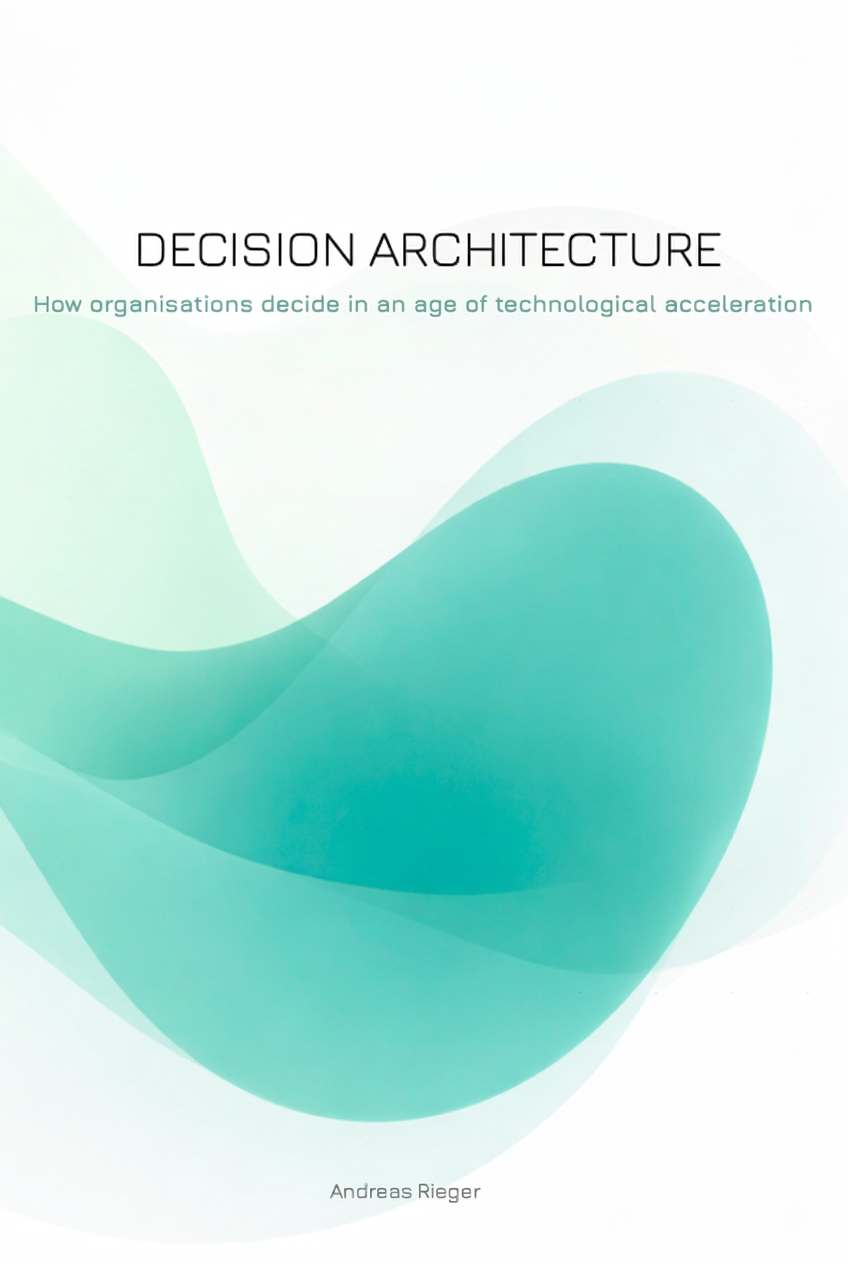
Decision Architecture
How Organisations Decide in an Age of Technological Acceleration
A reflective examination of the structural conditions under which decision remains possible when knowledge expands faster than the capacity to act on it.
Currently available in English only.
Available Editions
This book is available as an eBook, paperback and hardcover.
Amazon
Availability and formats may vary by retailer.
About this book
Organisations have always depended on their ability to decide.
For much of modern history, this capacity appeared closely linked to the expansion of knowledge. As analytical tools improved and information became more accessible, institutions learned to observe their environments with increasing precision. Decision was expected to follow naturally from understanding.
Today this relationship is beginning to change. The growing adoption of artificial intelligence in particular is accelerating this shift, generating analytical capacity at a pace that frequently outstrips an organisation's ability to act on what it reveals.
Across industries, leaders are beginning to describe a quieter and more complex experience of organisational life. Analytical awareness expands continuously, signals become visible earlier and multiple interpretations tend to remain plausible for longer periods of time. Institutions often find themselves understanding their environments with unprecedented depth, while the task of translating that understanding into coordinated commitment becomes increasingly demanding.
What this book examines
This book examines the architectural conditions under which decision remains possible in such environments.
Rather than treating decision-making as a moment of choice or an expression of leadership style, Andreas Rieger explores how institutions organise the pathways through which knowledge becomes action. He introduces the concept of decision architecture to describe the structural relationships that shape how signals gain legitimacy, how authority stabilises interpretation and how commitment forms under conditions of expanding knowledge.
Drawing on the evolution of management thought as well as contemporary organisational experience, the book offers a reflective perspective on maturity, leadership and institutional design in an age of acceleration. It invites readers to reconsider familiar assumptions about intelligence, uncertainty and strategic direction.
The central proposition
In doing so, it suggests that the defining challenge for modern organisations may not lie in knowing more, but in remaining capable of deciding while understanding continues to unfold.
The essay series
The ideas developed in this book were first explored in a seven-part essay series published on this site. These essays served as the conceptual groundwork for the larger project and remain available for readers who wish to engage with the thinking as it originally unfolded.
About the author

Andreas Rieger works at the intersection of artificial intelligence, digital commerce and organisational leadership, with a focus on how organisations translate technological possibility into coherent decision-making under conditions of increasing complexity.
Over more than two decades in international operational environments, his work has centred on the observation that the success of digital initiatives depends less on systems than on clarity of responsibility and the structure of decisions surrounding them.
His advisory work and writing, including this book, reflect an ongoing exploration of these conditions, particularly in the context of AI, where expectations often exceed the organisational capacity required to apply such systems meaningfully.
Availability
This book is available as an eBook, paperback and hardcover.
Amazon
Availability and formats may vary by retailer.
Further exchange
If reading raises questions or a desire for exchange, you will find further information and contact options on the contact page.